Showing posts with label intuition. Show all posts

Friday, October 13, 2017

The Evolving Role of the Artist


Rupert Spira, twenty first century mystic and teacher of nonduality, sees the “mystic’s job is to explore the nature of reality, but more is required of the artist. He or she has to simultaneously make manifest the ongoing results of this enquiry in form. So the role of the artist is to provide a way that this presence can be approached and experienced through the senses. The artist has to re-present our world of conceptualised objects, separated and extended in space and time, as it really is. He has to reinterpret our model of reality in line with direct experience and to convey this ‘taste of eternity’. We could call this twofold activity contemplation and creativity. Contemplation is the passive aspect; creativity is the dynamic aspect. These are two inseparable aspects of consciousness.”

The fourteenth century German mystic, Meister Eckhart, believed that “God dwells within you - as you,” or “I can only be fully known by becoming God.”  Eckhart wrote prolifically on the subject and was charged but never convicted of heresy for his writings.  His direct identification with the divine can also be seen in the works of Shankara, James, Blake, Rumi and many great saints and sages of the wisdom traditions.  Author Aldous Huxley  believed that most enlightened beings also practice this philosophy. Within the God space in us peace can be found, and here, mystical and aesthetic experiences and transformational events can unfold.

The nineteenth century artist and philosopher, Benedetto Croce, believed this peaceful God space to be the spirit within us from which we draw our inspiration.  He tells us that the externalization of intuition is secondary to its appearance in the consciousness of the artist, and that the expression of intuition is meaningful apart from the projection or form it takes in a work of art.  With art as the embodiment of spirit through intuition, we symbolize feelings, Nature, soul, God.

The role of the artist, then, is to bring the other, or viewer, to that place in consciousness through the form presented – into Nature, soul, feelings, God, where we can be, ourselves, inspired, and feel ourselves a complete microcosm of life’s macrocosm.  In this way, we connect with and become our own aesthetic holon, nesting with all others in unity consciousness.

What do YOU think?

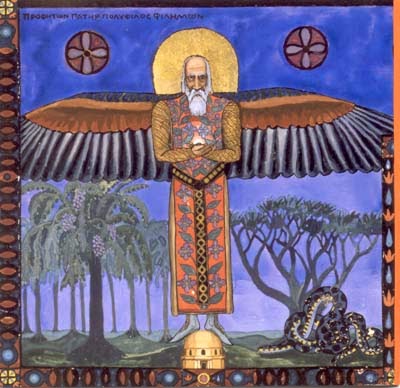
Artwork by Ron Isom  Many thanks.

Sunday, January 8, 2017

What do we do? What do we do?

--> -->
Merriam-Webster defines the word “do” as ways we act, behave, get alone, fare, manage, happen, finish and serve, among others.  Often our actions require our ability to rationally ascertain the context of our actions, the possible consequences of our actions and the ethics of our actions before we do anything.  Or do they?  Our actions, I think, like our words, are very clear indications of our state of mind.  Sociopaths would act differently than saints in the same circumstances, because they bring to the moment, a different frame of reference, different viewpoint and different foundation for action.
There are psychologies to both doing and doing nothing.   Yes, there are rational-emotional models of the factors that predispose humans to do nothing.   And there are theories of the psychology of action, which take into account reasoning abilities, emotion, attitude and other factors.
When our belief system holds God and Divine Action, our state of mind is very different than states that do not hold that belief, and our actions may reflect these differences.  To understand and bridge these differences, The Vatican Observatory (VO) and the Center for Theology and Natural Sciences (CTNS) jointly sponsor a series of conferences on divine action. The theme of each conference is an area of the natural sciences: quantum cosmology and the laws of nature (1992), chaos and complexity (1994), evolutionary and molecular biology (1996), neuroscience (1998), and quantum mechanics (2000). This brings specificity and precision to the discussions of divine action. In one of the papers from these conferences, along with summaries of many others, is posted on the CTNS website:  In “The Metaphysics of Divine Action,” John Polkinghorne notes that any discussion of agency requires the adoption of a metaphysical view of the nature of reality. He claims that there is no “deductive” way of going “from epistemology to ontology,” but the strategy of critical realism is to maximize the connection. This leads most physicists, he claims, to interpret Heisenberg’s uncertainty principle as implying an actual indeterminacy in the physical world, rather than an ignorance of its detailed workings.  Polkinghorne’s summary on the nature of Divine Action includes the insight that divine agency has its own special characteristics and that God’s knowledge of the world of becoming will be truly temporal in character.
In his book, Religion in late Modernity   Robert C. Neville,  suggests that these inquires  “concerning divine action takes its rise from people who affirm as a supposition the belief that God is a personal being of some sort.”
In A Search for God In Ancient Egypt, by Jan Assmann, divine action and religious experience are part of the cosmic dimension of the mystic experience.  Here, divine action is implicit in all contact with the divine once transcendence into Divine Presence has been realized.  In other words, our actions become Divine Action, while in the presence of the One within.
To Bernard de Clairvaux, mysticism is the highest degree of the scale of love and “a perfect participation in the love which God has from Himself in the unity of the Spirit…to become thus is to be deified.”  Our actions are naturally inspired from this unity of the Spirit that pervades our state.
This idea is similar to the mystical divine action, our own action, taken as a result of our mystical union with the God with us.  The mystic Jan Ruysbroeck suggests in mystical union God “breathes us out from Himself that we may love and do good works; and again he draws us into Himself, that we may rest in fruition.”
Our efficacy and actions then, may be defined by whether or not we believe in God, and if we believe that God is external and personal, or a state of being within ourselves.  What do YOU think?

Artwork by Beth Nash.  Many thanks.

Tuesday, July 7, 2009

Spend the Day in Beauty


What is beauty? Is being beautiful like tasting good to Bob (subjective) or being 150 lbs. (objective)? The saying “beauty is in the eye of the beholder” suggests subjective. But other sayings—“beauty is truth” or “beauty is eternal”—suggest there is some objective quality to beauty. Advocates of the subjective view emphasize how difficult it is to get people to agree on aesthetic judgments. Advocates of the objective view make arguments like: “The Grand Canyon would be beautiful regardless of whether anyone was there to see it, so beauty is in the object.”

Aristotle believed that there was no absolute beauty, but that it was based on perception. As a general term, the Greeks perceived beauty as interchangeable with excellence, perfection, and satisfaction. Plotinus believed that beauty did not include symmetry. However, "beauty is that which irradiates symmetry, rather than symmetry itself."

Plato introduced to the ideal of "Platonic love:" Plato saw love as motivated by a longing for the highest form of beauty—The Beautiful Itself, and love as the motivational power through which the highest of achievements are possible.

Kant argues that such aesthetic judgments are 'judgments of taste', and insists that universality and necessity are in fact a product of features of the human mind (Kant calls these features 'common sense'), and that there is no objective property of a thing that makes it beautiful.

The Taoist sage also thinks it is human judgment that what happens is beautiful or ugly, right or wrong, fortunate or not. The sage knows all things are one (equal) and does not judge. Our lives are snarled and jumbled so long as we make conventional discriminations, but when we set them aside, we appear to others as extraordinary and enchanted.

Benedetto Croce, originator of the modern “expressionist theory” of aesthetic, maintains that the difference between the beautiful and the ugly is that: “expression in the naturalistic sense simply lacks expression in the spiritual sense, that is to say, the very character of activity of the spirituality, and therefore the bipartition into the poles of beauty and of ugliness.” He sees beauty as part of the process of aesthetic expression that has four stages: impressions, expression or spiritual aesthetic synthesis (intuition), pleasure of the beautiful, translation of the aesthetic fact into physical phenomena. The expressive process is exhausted when these four phases have been passed through.

What do YOU think?